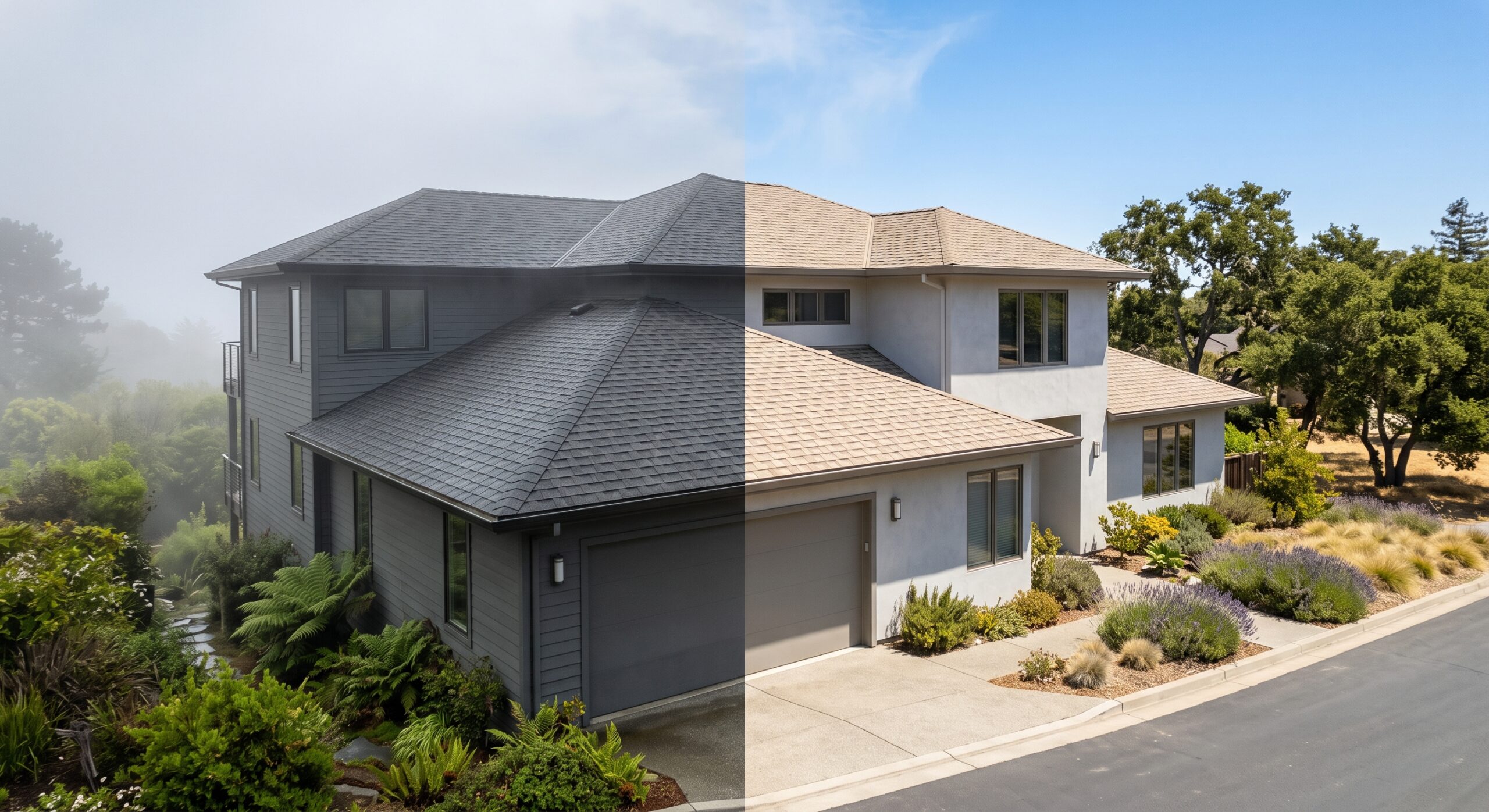
Moving just 30 miles across the San Francisco Bay Area can transport you into a completely different climate zone. If you move from the damp, marine-fog blanket of Pacifica to the sun-drenched valley floor of San Jose, your lifestyle isn’t the only thing that changes your roof’s operational environment completely shifts.
Many homeowners assume a high-quality asphalt shingle works everywhere. However, an architectural shingle designed to withstand moisture along the coast will fail prematurely under the intense heat and UV exposure of the South Bay.
To protect your home investment, you must match your roofing system and its underlayment to your specific local microclimate.
1. The Coastal Zone (Pacifica, Half Moon Bay, Daly City): Defending Against Moisture & Algae
Along the coast, roofs face liquid water exposure for 8 to 10 hours on summer mornings without a single drop of rain falling. Heavy marine fog deposits constant moisture onto shingle surfaces, while salt-laden coastal winds test fastener integrity.
- The Threat: Biological Growth & Granule Loss. Constant dampness creates an ideal breeding ground for Gloeocapsa magma (blue-green algae), moss, and lichen. These organisms root into the shingle surface, causing premature granule separation and wood rot.
- The Shingle Solution: Look for Algae-Resistant (AR) shingles featuring high concentrations of copper-infused or zinc-infused granules. Rainwater releases trace metal ions across the roof deck, creating a surface environment hostile to algae and moss growth.
- Underlayment Priority: High-moisture zones require breathable synthetic underlayment combined with self-adhering ice-and-water shield barriers at the eaves and valleys to prevent moisture from saturating the wood deck underneath.
2. The Valley Floor Zone (San Jose, Sunnyvale, Santa Clara): Defending Against UV & Heat
Head south into the Silicon Valley basin, and the primary roof enemy shifts from wet moisture to relentless solar radiation and high temperatures.
- The Threat: Asphalt Baking & Thermal Shock. Unfiltered ultraviolet (UV) radiation bakes asphalt shingles, evaporating essential volatile oils. Over time, this leads to asphalt embrittlement, thermal cracking, and curling edges. Unventilated attics can easily cook roof decks from the inside out.
- The Shingle Solution: Choose Title 24 “Cool Roof” shingles engineered with infrared-reflective granules. These specialized ceramic granules reflect solar radiation away from your home, maintaining structural flexibility and reducing indoor cooling costs.
- Underlayment Priority: High-heat zones require high-temperature synthetic underlayments that won’t melt, degrade, or adhere permanently to the deck frame when exposed to extreme attic temperatures.
Microclimate Roofing Match Guide
| Climate Threat | Primary Location | Key Shingle Feature | Underlayment Focus |
| Heavy Moisture & Marine Fog | Pacifica, Daly City, Half Moon Bay | Algae-Resistant (AR) Copper Granules | Self-adhering waterproof leak barrier |
| High UV & Thermal Expansion | San Jose, Sunnyvale, Santa Clara | Title 24 Cool Roof Reflective Granules | High-temp tear-resistant synthetic |
| Wind & Hillside Exposure | San Carlos, Belmont, Los Gatos | Class 4 Impact & High-Wind Rated | Reinforced dual-layer deck protection |
3. Why Underlayment Is Your Second Line of Defense
While shingles take the direct impact of weather, the roofing underlayment sitting beneath them serves as your primary waterproofing layer.
Installing standard organic felt paper in a high-moisture zone like Pacifica leads to trapped condensation, rot, and buckled shingles. Conversely, standard underlayments installed in San Jose often break down due to ambient heat transfer. Matching the underlayment material to your microclimate is just as critical as choosing the right shingle color or brand.
Before choosing new roofing materials for your home, take time to check for existing climate wear. Review our May roof maintenance checklist to spot warning signs early, or read our guide on the average lifespan of a roof in the Bay Area.
Protect Your Investment with Bay 101 Roofing
Whether you are living on the foggy coast or in the sunny South Bay valley, your home needs a climate-engineered roof. Bay 101 Roofing is a Diamond Certified contractor serving San Mateo and Santa Clara counties. We perform complete microclimate roof evaluations, recommending the ideal shingle-and-underlayment combination backed by our 10-year workmanship warranty.
Ensure your roof is engineered specifically for your neighborhood’s weather.
Schedule a Free Microclimate Roof Consultation or call our local team today at (408) 957-0531 to speak directly with a local roofing expert.